Most SaaS companies start paid acquisition with a simple goal:
Generate more demos. Build more pipeline. Grow revenue faster.
At first, paid ads often look promising.
Spend increases. Leads come in. Demo volume improves.
But after a certain point, something changes.
CAC starts rising. Lead quality becomes inconsistent. Sales teams complain about poor-fit demos. Pipeline becomes harder to predict.
This is one of the most common problems SaaS companies face when scaling paid acquisition.
The issue is not that Google Ads, LinkedIn Ads, or Meta Ads stop working.
The issue is that scaling exposes weaknesses in the acquisition system.
Why CAC Usually Looks Good at the Beginning
At lower budgets, ad platforms naturally find the easiest opportunities first.
This usually includes:
- Higher-intent buyers
- Warmer audiences
- Stronger-fit prospects
- Easier conversion paths
That is why early paid acquisition can look efficient.
You are often reaching the best audience first.
But once budget increases, platforms need to find more people to spend against.
That means you start reaching broader, colder, and lower-intent audiences.
And that is where CAC begins to climb.
The Real Reason CAC Increases After Scaling
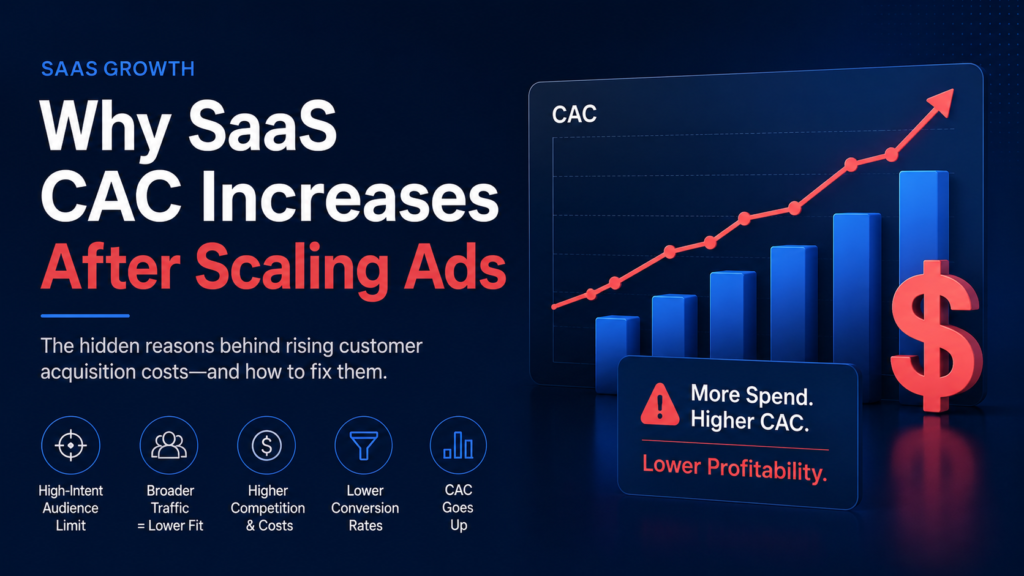
CAC increases because scaling changes the quality of traffic, the cost of reach, and the pressure on your funnel.
At $10K/month, inefficiencies may not look serious.
At $50K/month, those same inefficiencies become expensive.
At $100K/month, they can break the entire growth model.
Scaling does not create problems from nowhere.
It magnifies problems that were already inside the system.
1. You Exhaust the Highest-Intent Audience First
In SaaS, the highest-intent users are usually people searching for:
- Specific software categories
- Competitor alternatives
- Pricing comparisons
- Use-case-specific solutions
- Demo-ready product searches
These prospects are easier to convert because they already understand the problem.
But this audience is limited.
Once you scale beyond that initial demand, you need to reach people who are:
- Earlier in the buying journey
- Less aware of your solution
- Comparing multiple options
- Not ready to book a demo yet
That traffic costs more to convert.
The result is higher CAC.
2. Broader Targeting Reduces Lead Quality
To spend more, SaaS teams often expand targeting too quickly.
They add broader keywords. They widen audiences. They rely more on automation. They push campaigns beyond proven segments.
This increases volume, but often reduces quality.
More leads do not always mean more revenue.
If the additional leads are not qualified, sales efficiency drops.
That means your team spends more time on:
- Poor-fit demos
- Low-budget prospects
- Unqualified companies
- Users who are not decision-makers
This increases the true cost of acquisition.
3. SaaS Teams Optimize for CPL Instead of Revenue
One of the biggest mistakes in SaaS advertising is optimizing for cost per lead.
A low CPL can look good in reports.
But if those leads do not become pipeline or customers, the campaign is not working.
SaaS companies should not optimize only for:
- Clicks
- Form submissions
- Demo bookings
- Cost per lead
They should optimize for:
- Sales-qualified leads
- Pipeline generated
- Opportunity creation
- Customer acquisition cost
- Lifetime value
When campaigns optimize for volume instead of revenue, CAC usually rises as spend scales.
4. Landing Pages Are Not Built for Scale
Many SaaS companies send paid traffic to:
- Homepages
- Generic product pages
- Feature-heavy pages
- Broad demo forms
This may work at small budgets, but it usually fails at scale.
As traffic expands, landing pages need to become more specific.
High-performing SaaS campaigns use landing pages built around:
- One industry
- One use case
- One buyer persona
- One pain point
- One clear CTA
A CFO, marketing leader, IT director, and founder should not all land on the same generic page.
The more specific the landing page, the easier it is to convert qualified traffic.
5. Poor Qualification Creates Sales Waste
If anyone can book a demo, everyone will.
That creates a problem.
Your sales team may start speaking with:
- Students
- Freelancers
- Very small companies
- Low-budget users
- Poor-fit prospects
At low volume, this is manageable.
At scale, it becomes expensive.
A strong SaaS funnel should qualify leads before they reach sales.
This can include:
- Company size
- Role
- Use case
- Budget range
- Timeline
- Current solution
Qualification does not reduce growth.
It improves the quality of growth.
6. CRM and Revenue Data Are Missing
Many SaaS teams track ad performance only inside ad platforms.
That creates a blind spot.
Google Ads or LinkedIn Ads may show conversions, but that does not tell you:
- Which leads became SQLs
- Which demos became opportunities
- Which opportunities became customers
- Which campaigns produced revenue
- Which keywords produced high-LTV accounts
Without CRM data, campaigns are optimized based on incomplete information.
That leads to more spend on campaigns that look good but do not produce revenue.
At scale, this becomes very expensive.
7. Retargeting Is Too Weak
Most B2B SaaS buyers do not convert on the first visit.
They compare vendors. They read reviews. They talk to teams. They revisit pricing pages. They evaluate alternatives.
If you are only focused on cold acquisition, you are missing a large part of the buying journey.
Retargeting helps bring high-intent prospects back with:
- Case studies
- Product comparisons
- Demo reminders
- Customer proof
- Objection-handling content
Without retargeting, CAC increases because every conversion depends too heavily on first-touch traffic.
8. Sales Follow-Up Is Not Fast Enough
Paid ads do not stop at the form fill.
Speed matters.
If a qualified demo request waits hours or days before follow-up, conversion rates drop.
As spend increases, slow follow-up becomes a hidden CAC problem.
Strong SaaS teams optimize:
- Speed to lead
- Demo confirmation
- Email follow-up
- Sales handoff
- CRM automation
Marketing cannot scale efficiently if sales follow-up is weak.
What Healthy SaaS Scaling Looks Like
Scaling paid ads successfully does not mean CAC never increases.
Some CAC increase is normal as you reach broader audiences.
The goal is not to keep CAC artificially low forever.
The goal is to ensure CAC remains profitable as revenue grows.
Healthy scaling usually means:
- Pipeline increases faster than wasted spend
- Lead quality stays controlled
- Sales efficiency remains strong
- CAC stays within acceptable payback limits
- LTV supports continued acquisition
In SaaS, scaling is not just about more traffic.
It is about better systems.
How SaaS Companies Can Control CAC While Scaling
To scale without letting CAC spiral, focus on these areas:
1. Segment campaigns by intent
Separate:
- Brand campaigns
- Non-brand campaigns
- Competitor campaigns
- Use-case campaigns
- Industry-specific campaigns
This gives better control over budget and performance.
2. Build dedicated landing pages
Do not send every click to the same page.
Create landing pages around:
- Industry
- Use case
- Persona
- Pain point
- Buying stage
Specificity improves conversion quality.
3. Optimize for SQLs and pipeline
Move beyond CPL.
Track:
- Demo quality
- SQL rate
- Opportunity rate
- Pipeline value
- Closed revenue
This helps you scale what actually creates business impact.
4. Improve qualification
Use better forms, routing, and scoring.
The goal is not more demos.
The goal is better demos.
5. Build full-funnel retargeting
Retarget users based on behavior:
- Website visits
- Pricing page visits
- Demo page visits
- Content engagement
- Competitor comparison interest
This improves conversion efficiency over time.
6. Connect ads to CRM data
Your ad strategy should not end at lead generation.
Connect ad data to:
- HubSpot
- Salesforce
- Pipedrive
- Close
- Other CRM systems
This allows campaign decisions based on revenue instead of surface-level conversions.
Final Thought
SaaS CAC increases after scaling ads because the system becomes more complex.
You are no longer buying the easiest traffic.
You are expanding into broader, more expensive, and harder-to-convert audiences.
That does not mean scaling is broken.
It means your acquisition system needs to mature.
The SaaS companies that scale efficiently do not just spend more.
They build:
- Better segmentation
- Better landing pages
- Better qualification
- Better attribution
- Better retargeting
- Better sales alignment
More spend does not create predictable growth.
Better systems do.