
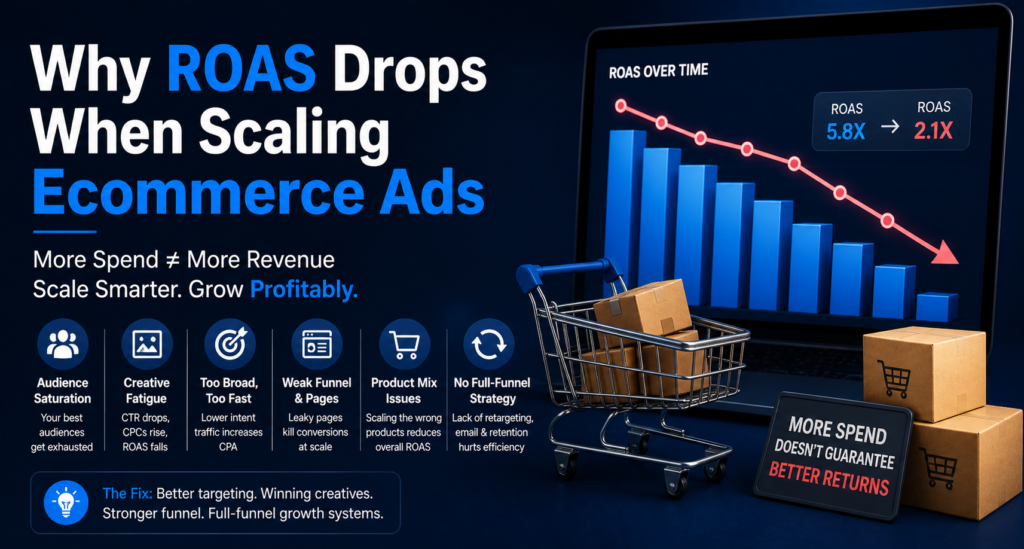
For most ecommerce brands, paid ads are easy in the beginning.
At lower budgets:
- ROAS looks strong
- CPA feels manageable
- Revenue scales quickly
A few winning campaigns can produce excellent returns.
Then brands try to scale.
Budgets increase. Traffic expands.
And suddenly:
- ROAS drops
- CAC rises
- Margins shrink
- Growth becomes unpredictable
This is one of the most common frustrations in DTC and ecommerce scaling.
The issue is not that ads stop working.
The issue is that scaling changes performance dynamics.
Why ROAS Drops as Spend Increases
At lower budgets, platforms prioritize:
- Highest-converting audiences
- Strongest product-market fit segments
- Lowest-cost opportunities
These are your easiest wins.
Once spend increases:
- Audience pools widen
- Lower-intent traffic enters
- Competition increases
- CPCs rise
- Creative fatigue accelerates
In short:
The easiest conversions get exhausted first.
Scaling requires reaching more expensive users.
The 6 Biggest Reasons Ecommerce ROAS Declines
1. Audience Saturation
At smaller budgets, you target the best audiences first.
As spend increases:
- Frequency rises
- CTR declines
- Conversion rates fall
Your best audience eventually becomes oversaturated.
2. Creative Fatigue
One of the largest DTC killers.
Winning creatives lose effectiveness over time.
As impressions grow:
- Ad fatigue rises
- CPC increases
- Engagement drops
Brands that fail to refresh creatives consistently often see ROAS collapse.
3. Broad Expansion Too Fast
Many ecommerce brands scale by:
- Broadening targeting aggressively
- Increasing budgets rapidly
- Expanding before validating funnel strength
This introduces:
- Lower purchase intent
- Less qualified traffic
- Higher CPA
4. Weak Landing Pages or Product Pages
Scaling traffic into weak pages magnifies inefficiencies.
Common issues:
- Slow site speed
- Weak offer positioning
- Poor mobile UX
- Lack of trust signals
More traffic into a weak funnel = lower ROAS.
5. Product-Level Inefficiency
Not every product scales equally.
Brands often increase spend across all SKUs instead of prioritizing:
- High-margin products
- Best-converting offers
- Strong LTV segments
This reduces overall account efficiency.
6. Lack of Full-Funnel Systems
Many brands rely too heavily on acquisition.
But at scale:
- First-touch conversions decline
- Retargeting becomes critical
- Email/SMS becomes essential
Without full-funnel systems, ROAS almost always weakens.
What Successful Ecommerce Scaling Looks Like
Brands that scale profitably focus on:
Better Audience Expansion
Scale gradually through:
- Lookalikes
- Product-specific campaigns
- Search intent expansion
- Funnel segmentation
Continuous Creative Testing
Winning brands constantly refresh:
- Hooks
- UGC
- Offers
- Product positioning
Product Prioritization
Scale around:
- Margin
- AOV
- LTV
- Conversion rate
Retargeting Systems
Recover:
- Cart abandoners
- Product viewers
- Returning customers
Multi-Channel Growth
Use:
- Meta
- Native
- Email/SMS
- Amazon
The Reality of Scaling
ROAS often declines somewhat as spend increases.
That’s normal.
The goal is not to keep ROAS artificially high forever.
The goal is to scale profitably while maintaining strong margins.
If:
- Revenue grows
- CAC remains controlled
- Contribution margin stays healthy
Then scaling is working.
Biggest Mistakes Ecommerce Brands Make
- Scaling too fast
- Ignoring creative fatigue
- Over-relying on one platform
- Expanding targeting too broadly
- Weak product pages
- No retention systems
Final Thought
ROAS drops during scaling because:
- Easy wins get exhausted
- Audiences widen
- Costs rise
- Systems matter more
Scaling ecommerce ads successfully requires:
Better creative – Better funnels – Better segmentation – Better retention
It’s not just about spending more.
It’s about building a system that can scale profitably.