Scaling Google Ads is easy in theory.
Increase the budget. Turn on automation. Add more keywords.
In reality, most DTC brands discover something frustrating: performance drops as spend increases.
Cost per acquisition rises. ROAS declines. And suddenly scaling feels risky.
The truth is that scaling Google Ads isn’t about spending more money. It’s about building the structure that can handle growth.
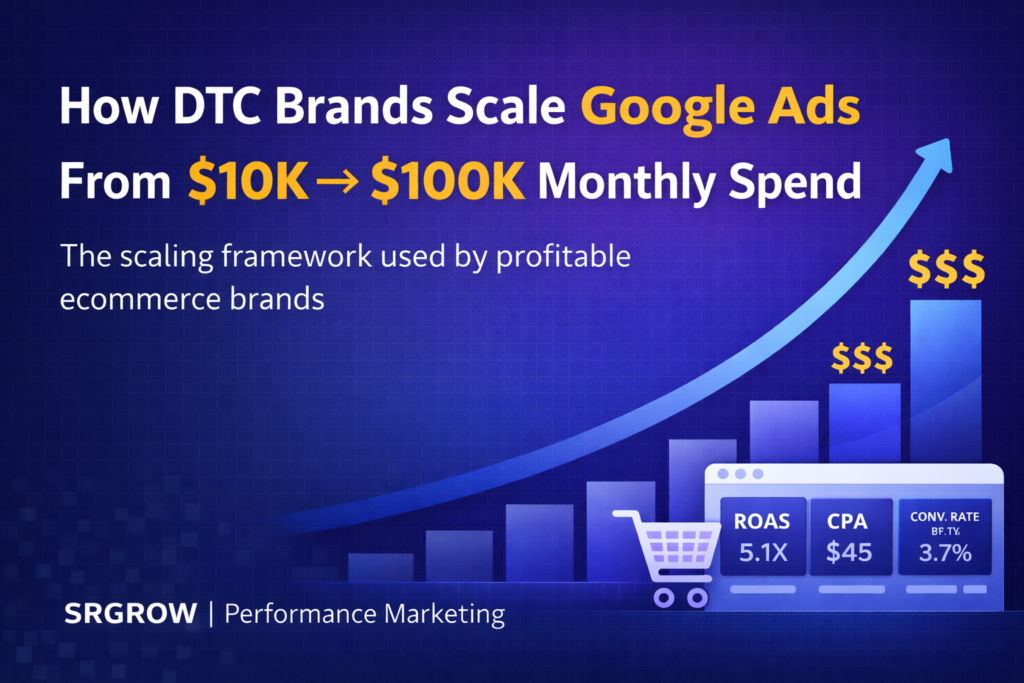
Here’s how successful DTC brands scale their Google Ads from $10K to $100K+ per month without destroying profitability.
Step 1: Build a Scalable Campaign Structure
Many e-commerce brands start with a simple setup:
- One shopping campaign
- One search campaign
- A few remarketing ads
This works at low budgets, but it doesn’t scale.
Brands spending $50K+ per month usually structure campaigns around:
• Brand campaigns – protecting branded searches
• Non-brand search campaigns – capturing high-intent product queries
• Shopping campaigns – product-driven traffic
• Performance Max campaigns – expanding reach
• Remarketing campaigns – converting returning visitors
Separating campaigns by intent allows you to control budget allocation and performance more precisely.
Step 2: Focus on High-Intent Search Traffic
Scaling Google Ads profitably depends on capturing buying intent.
High-performing ecommerce campaigns prioritize keywords like:
- buy [product]
- best [product category]
- [product] online
- [brand alternative]
These searches come from users who are ready to purchase.
Many brands waste budget targeting informational searches that rarely convert.
When scaling budgets, prioritizing intent becomes even more important.
Step 3: Optimize Product Feed for Shopping Ads
For e-commerce brands, Google Shopping and Performance Max campaigns often drive the majority of revenue.
But many brands treat the product feed as an afterthought.
A well-optimized product feed includes:
- Keyword-rich product titles
- Detailed product descriptions
- High-quality images
- Accurate categories and attributes
Feed optimization improves visibility and click-through rates, which becomes critical when budgets increase.
Step 4: Improve Conversion Rate Before Scaling
One of the biggest scaling mistakes is increasing ad spend without improving conversion rate.
If your site converts at:
- 1.5%, scaling will be expensive
- 3–4%, scaling becomes far easier
Before increasing budgets, successful brands focus on:
- Faster page speed
- Clear product messaging
- Simplified checkout
- Trust signals and reviews
Small improvements in conversion rate dramatically improve the economics of scaling ads.
Step 5: Use Remarketing to Capture Lost Buyers
Only a small percentage of visitors buy on the first visit.
Remarketing campaigns allow brands to bring back shoppers who:
- Viewed products
- Added items to cart
- Compared options but didn’t purchase
These audiences often convert at a much higher rate than cold traffic.
Remarketing also improves overall ROAS when scaling budgets.
Step 6: Monitor Profitability, Not Just ROAS
Many e-commerce brands rely solely on ROAS when evaluating performance.
But ROAS alone can be misleading.
Scaling decisions should also consider:
- Cost per acquisition (CPA)
- Contribution margin
- Customer lifetime value (LTV)
- Repeat purchase behavior
Brands that understand these metrics can scale confidently even when ROAS fluctuates.
Why Many DTC Brands Struggle to Scale
Google Ads don’t stop working at higher budgets.
What actually happens is that scaling exposes weaknesses such as:
- Poor campaign structure
- Unoptimized product feeds
- Low conversion rates
- Weak remarketing strategies
- Misaligned performance metrics
Without fixing these issues, increasing spend simply increases inefficiency.
What Scaling Should Look Like
When Google Ads are structured correctly, scaling from $10K to $100K monthly spend typically results in:
- Higher revenue volume
- Stable or improving CPA
- Consistent customer acquisition
- Predictable sales growth
That’s when paid ads become a reliable growth engine, not a risky experiment.