
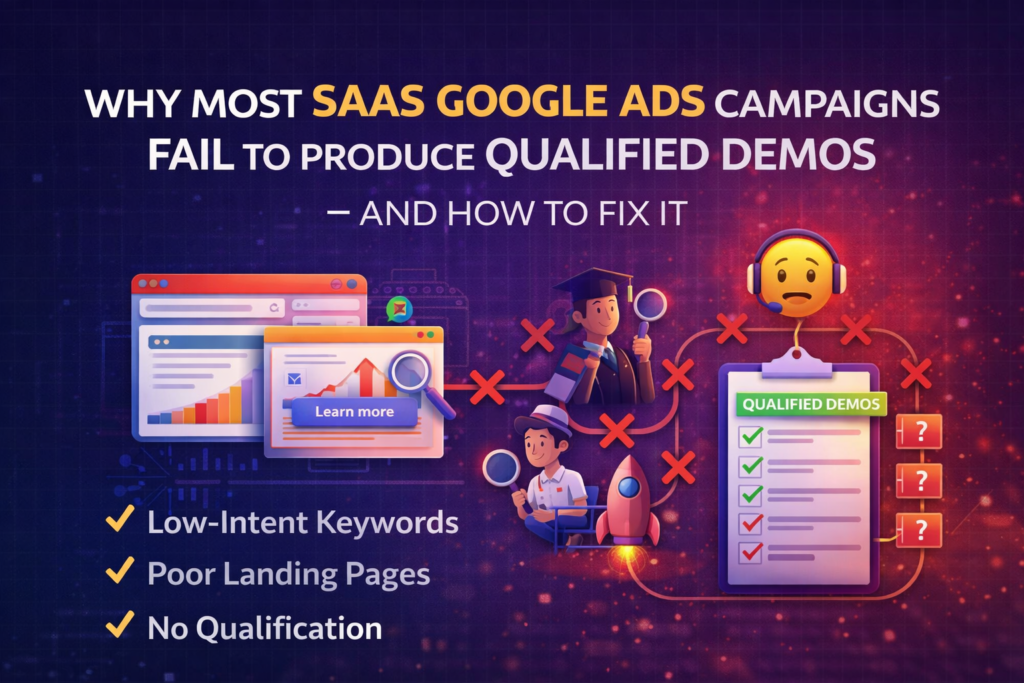
Most SaaS companies don’t struggle to generate traffic.
They struggle to generate qualified demos.
On paper, campaigns look fine:
- Clicks are coming in
- Cost per lead looks reasonable
- Demo bookings are happening
But sales teams say something different:
“These leads aren’t qualified.”
This is where most SaaS Google Ads campaigns fail.
Not at traffic. At intent, qualification, and funnel alignment.
The Real Problem: Optimizing for Leads Instead of Revenue
Many SaaS campaigns optimize for:
- Cost per lead (CPL)
- Form submissions
- Conversion rate
This creates a dangerous outcome:
- More leads, but worse quality
Google’s algorithm will optimize for volume, not fit, unless told otherwise.
That’s why many campaigns produce:
- Students
- Researchers
- Low-budget users
- Non-decision makers
Instead of:
- Buyers
- Teams evaluating tools
- High-intent prospects
Problem #1: Targeting the Wrong Keywords
Most SaaS accounts rely too heavily on:
- Broad keywords
- Informational searches
- Generic industry terms
Examples:
- “What is CRM software”
- “Best marketing tools”
These attract users who are early in the research phase, not ready to book demos.
High-performing campaigns focus on:
- “CRM software for SaaS startups”
- “Best CRM for sales teams pricing”
- “[Competitor] alternative”
- “[Use case] platform demo”
These searches indicate buying intent.
Problem #2: Sending Traffic to the Wrong Pages
Many SaaS companies send ad traffic to:
- Homepages
- Feature-heavy product pages
- Generic “About” pages
This reduces demo conversion and attracts unqualified users.
A better approach:
- Use use-case-specific landing pages
Each page should:
- Speak to a specific ICP
- Focus on one problem
- Offer a clear next step (demo or trial)
- Filter out poor-fit users
This increases both conversion rate and lead quality.
Problem #3: No Qualification in the Funnel
If anyone can book a demo, everyone will.
That includes:
- Freelancers with no budget
- Students
- Competitors
- Early-stage startups
Qualified demo funnels include:
- Company size selection
- Role or job title
- Budget range
- Use-case questions
This doesn’t reduce leads. It improves sales efficiency.
Problem #4: No Connection to Revenue Data
Most SaaS companies don’t connect Google Ads to:
- CRM
- Sales pipeline
- Closed deals
So campaigns are optimized for:
- Leads
- Not revenue
Without revenue tracking, Google can’t learn:
- Which keywords produce customers
- Which campaigns generate pipeline
- Which segments are profitable
This is one of the biggest reasons demo quality suffers.
Problem #5: Ignoring the Sales Feedback Loop
Marketing and sales often operate separately.
Marketing focuses on:
- Leads
- CPL
- Conversion rates
Sales focuses on:
- Qualified opportunities
- Close rates
- Deal size
Without feedback, campaigns continue generating low-quality demos.
High-performing teams align both sides:
- Weekly feedback loops
- Lead scoring
- Pipeline tracking
What a High-Performing SaaS Google Ads System Looks Like
A system that generates qualified demos includes:
- Intent-based keyword targeting
- ICP-specific landing pages
- Funnel-level qualification
- CRM integration with ads
- Continuous optimization based on revenue
This turns Google Ads from a lead channel into a pipeline engine.
The Outcome: Fewer Leads, Better Demos
When campaigns are structured correctly:
- Lead volume may decrease
- Demo quality increases
- Sales efficiency improves
- CAC decreases over time
That’s the real goal.
Not more leads. Better customers.
Is Your SaaS Campaign Built for Qualified Demos?
If you’re currently running Google Ads and:
- Getting demos but poor close rates
- Seeing rising CAC
- Struggling with lead quality
The issue is likely not traffic — it’s structure.
If you want clarity, you can book a free strategy call:
👉 https://calendly.com/srgrow-marketing/30min
We’ll review your campaigns, funnel, and demo quality.
No pressure — just insight.