
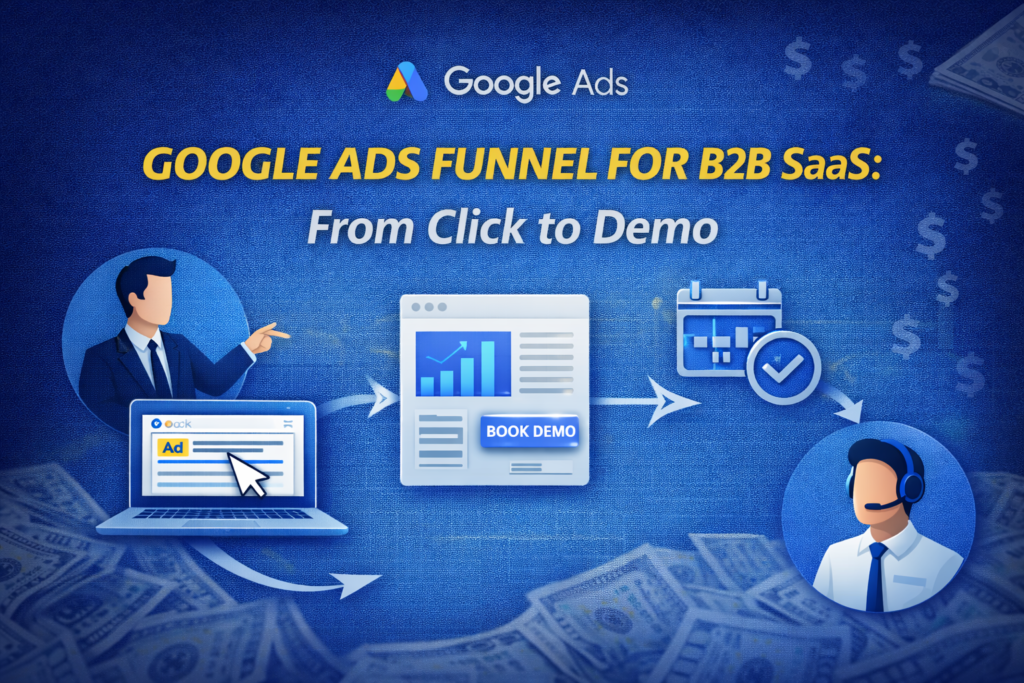
Most B2B SaaS companies run Google Ads.
Few build a proper funnel.
The result?
Clicks increase.
Demo bookings fluctuate.
Cost per demo rises.
Sales complain about lead quality.
Google Ads don’t fail because of traffic.
They fail because the funnel between click and demo is broken.
Here’s how a scalable B2B SaaS Google Ads funnel actually works.
Step 1: Intent-Based Campaign Structure (Not Broad Targeting)
Predictable demos start with buyer-intent keywords.
Avoid:
- “What is X software”
- Educational or informational queries
- Extremely broad industry terms
Instead focus on:
- “Best X software for Y”
- “X platform pricing”
- “X software demo”
- “Alternative to [Competitor]”
- “[Use case] solution for [industry]”
These searches come from users already in evaluation mode.
That dramatically increases demo conversion probability.
Step 2: Single-Intent Landing Pages (Not Homepages)
Most SaaS companies send traffic to:
- The homepage
- Generic product pages
- Overloaded feature lists
That kills demo conversion.
A high-performing SaaS funnel uses:
- One landing page per keyword theme
- Clear problem → solution framing
- Industry-specific messaging
- Focused demo CTA
- Light qualification (role, company size, etc.)
This increases demo quality and filters out low-fit leads.
Step 3: Optimize for Qualified Demo, Not Cost Per Lead
Many SaaS teams optimize for:
- Lowest CPL
- Highest conversion rate
That’s a mistake.
The right metric is:
- Cost per qualified demo
- Demo-to-opportunity rate
- Pipeline generated per keyword
Cheap demos that never close are expensive.
High-intent demos that close justify higher CPL.
Step 4: Retarget Evaluation Traffic
Not every high-intent visitor books immediately.
Retargeting should:
- Re-engage comparison shoppers
- Promote case studies
- Push demo reminders
- Address objections
This increases demo conversion rate without increasing cold traffic spend.
For SaaS, retargeting often improves demo volume by 20–40%.
Step 5: Connect Ads to Revenue Data
The biggest difference between average and scalable SaaS accounts:
Revenue tracking.
When Google Ads are connected to:
- CRM
- Sales stage progression
- Closed-won revenue
You can:
- Pause keywords that don’t generate pipeline
- Scale campaigns that generate high-LTV customers
- Allocate budget based on real profitability
That’s when scaling becomes predictable.
What a Proper B2B SaaS Funnel Looks Like
Click →
Use-case-specific landing page →
Demo booking →
Sales qualification →
Pipeline tracking →
Revenue feedback loop →
Budget reallocation
This loop creates stability.
Without it, you’re guessing.
Why Most SaaS Google Funnels Collapse
They collapse because:
- Keywords are too broad
- Messaging isn’t ICP-specific
- Demo pages aren’t optimized
- Sales feedback isn’t integrated
- Budget increases before structure improves
Google Ads amplify your system.
If your funnel is tight, performance compounds.
If it’s weak, CAC explodes.
When This Funnel Works Best
This structure works best for SaaS companies that:
- Sell B2B
- Have defined ICPs
- Offer demos or sales calls
- Care about pipeline, not vanity metrics
- Spend $3K+/month on ads
If you’re serious about predictable demo flow, this is the architecture that supports it.
Want to See How Your Funnel Compares?
If you’re running Google Ads for your SaaS and:
- Demo volume is inconsistent
- CPL is rising
- Lead quality feels off
- Scaling feels risky
We can review your funnel structure and show where performance leaks exist.
Book a free strategy call:
https://calendly.com/srgrow-marketing/30min
No pressure — just clarity.